UKRAINE, KHARKIV — Christmas is valued by many in Ukraine. According to Zagoryi Foundation’s research, over 97% of their 3,200 respondents considered it the most important holiday in general and the most important religious holiday.
About 65% of those people sing koliadkas, traditional Christmas songs that are sung to people a singer or singers meet. These songs retell Biblical stories, wish for well-being, health, and good luck. Celebrate beauty, strength, or other qualities of the "recipient." For these performances — if one'd liked the koliadka — it’s a tradition to give money.
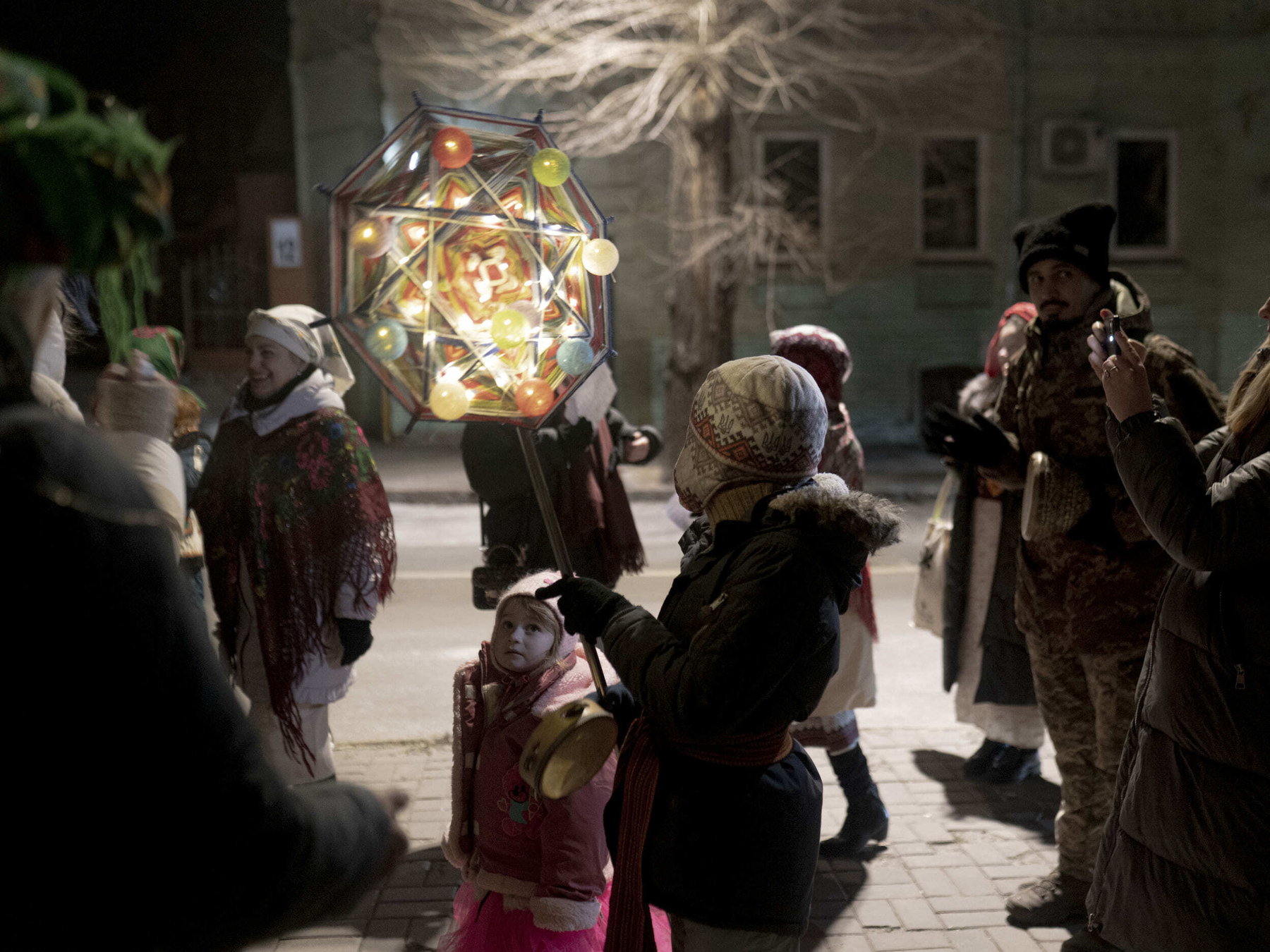
For the second year in a row, Ukraine has officially celebrated Christmas on Dec. 25 — previously, this holiday was celebrated on Jan. 7. On Dec. 24, Kharkiv locals gathered to celebrate Christmas Eve with koliadas, walking and singing along the streets of the city, located 30 kilometers (19 miles) from the Russian border. Gwara Media joined them.
Christmas celebrations took place in Kharkiv over the last weekend as well — and Gwara visited some of them.
On Dec. 21, the Ocheret theater held a festive caroling event on Vokzalna Square in Kharkiv.
“We wished people all the best for the coming year,” said Anastasia, one of the theater’s representatives.
She said that caroling and nativity plays, known as vertep, are old Ukrainian traditions that are unique and distinct from other countries’ Christmas events. She said that these traditions allow Ukrainians to identify themselves in the world.
“When we sing our Christmas carols and ‘Shchedryk’ (a famous Ukrainian carol known in English as ‘Carol of Bells’), we can identify ourselves as Ukrainians. We have all known these songs since childhood and pass them on in this way,” explained Anastasia.
The actors presented “Ocheretivska Koliada” — a theatrical Christmas performance with traditional characters from the Ukrainian vertep. Those are the Angel and the Chort (a magic spirit or demon in Slavic folk tradition), the Goat and Death, the bag carrier, and the star carrier.
They also had elements of Malanka, a New Year’s ritual with traditional dressing up as animals and folklore characters. Actors performed koliadkas and shchedrivkas (the latter are New Year’s songs or Malanka’s songs). The scenes of the vertep combined classical and modern elements.
Anastasia Koshel was the director of the production. The theater planned to invest money collected during the performances in heating for their theater building.
Also on December 21, Art Area DK and the Kharkiv Puppet Theater organized the fourth mini-festival Vertep Skhid. It featured the Savielievs’ performance “Rodinny Vertep” (family vertep in translation from Ukrainian), a performance by Folk Stream, and “Makabrichny Vertep” (macabre vertep) by the youth theater.
“Well, this year it's a bit of a compact format for us, all in one day,” said Oleksii Myhailov, the art director of the Art Area DK.
He shared that the goal of the festival is to focus on verteps in all possible ways, on all types of them. This time, there were more intimate and larger-scale performances, including two performances at the Puppet Theater.
“We were very happy that the tradition of the nativity scene now exists in Kharkiv,” said Iryna, one of the visitors.
Iryna came to the event with her daughter and shared that they wanted to support Ukrainian traditions more. “We want to learn more about them, because we really know very little,” said the woman.
Many in Ukraine see celebrating Christmas on Dec. 25 as a step away from Russian traditions. In the early Soviet Union, though, people celebrated this holiday on Dec. 25 and Jan. 7. The latter festivities were supported by the church and the former by the state (as the time ‘moved’ towards Dec. 25 as soon as the Soviets transitioned to the Gregorian calendar), says Daria Antsybor, anthropologist, in an interview with The Ukrainians media.
The Soviets banned Christmas in the second half of the 1920s and came up with a New Year holiday as a way to “unite new Soviet people” of all nationalities, Antsybor says. That became the supposedly neutral, secular replacement of both Christmases. Antsybor notes many in Ukraine didn’t know any particular Christmas traditions because of this and the ban. Now, some of them are indeed trying to learn more.
Read more
- “I won’t go through occupation again” — life in Ukrainian village one mile from Russia
Hi! Winter has come, and Russian airstrikes on power infrastructure disrupt our daily lives & work a lot here in Kharkiv. Despite it all, we keep working to bring you reports from the city and the Kharkiv region. Please consider supporting our newsroom with a one-time tip or become a member of our community.
The post Kharkiv locals celebrate Christmas Eve 30 kilometers from border with Russia — in photos appeared first on Gwara Media.