Editor’s note: This article was written by a reporter in Caracas who asked that we keep his identity hidden due to security risks.
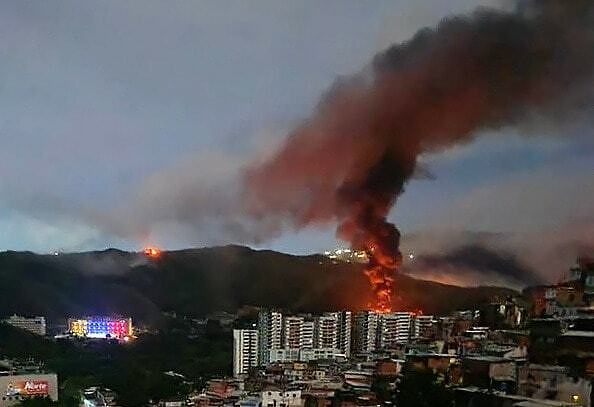
CARACAS, Venezuela – I heard the first strike at 1:55 in the morning. I was near La Carlota, a military base in the southeast of Caracas, visiting a friend of mine.
I must admit it took me off guard completely. It was a surprise for everyone. There were no alarms, no warnings at all.
The night was cloudy, with a full moon. I only heard the sound of planes and one loud explosion. I woke up my friend, warning that, maybe, a military strike is starting.
Everything else was silent: just the airplanes and the explosions.
My heart rate increased. I chatted with all my journalist friends: nobody knew anything. My WhatsApp started to fill with messages. We could only see a dark and cloudy sky. We could only hear airplanes and explosions.
Minutes later, at 02:16 a.m., a friend of mine sent me a message: “They strike [near] at 4F.” 4F is what Venezuelans called an old military base that is known as a museum of Hugo Chávez’ regime.
I turned on the TV, one of the little official communications that the regime had, and there were Christmas jingles, as well as pirated movies with propaganda.
That didn’t surprise me at all: for more than 20 years the Chávez and the Maduro regime have repressed the free press with violence. All we have are our families and friends’ messages. Audios, videos, texts passed with fear and information. My journalist friends were working to verify everything, but the strikes continued.
I told my friend to create an emergency kit: our IDs, our passport, some bottles of water and some flashlights. Friends from other countries, like Paraguay, Ecuador and the USA, reached me to know how I was, how I was doing.
I was fine, but nervous, just hearing the airplanes. It sounded like I lived near an airport… Except for the bombs.
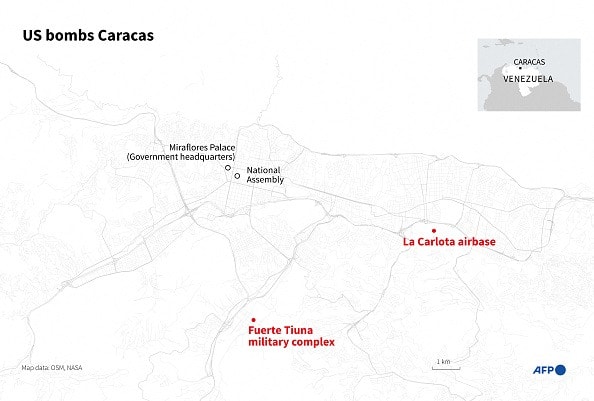
Other friends in El Valle, a neighborhood near a military base called Fuerte Tiuna, told me that the sky has turned orange and their windows are shaking a lot. And I was scared: Fuerte Tiuna has civilian neighborhoods.
Then, at 2:15 a.m., my aunt wrote to me: “They [struck] some television antennas near my home.” Those antennas were military equipment in El Volcán, a neighborhood to the southeast of Caracas.
Videos of La Guaira, a coastal state near Caracas, show that the port there has been bombarded too.
The Venezuelan regime has previously closed all kinds of platforms like Twitter, radio broadcast, television, and independent journalism web pages. People were expecting news from Nicolás Maduro or Vládimir Padrino López, the ministry of Defense in Venezuela, but we were met with silence.
The planes stopped near 3:10 a.m., just over an hour after it started.
Then, out of nowhere, there was the first official statement from Maduro´s regime on national television. Nobody from Maduro’s inner circle was present. They only said that those strikes were from the USA, the rest was socialist propaganda.
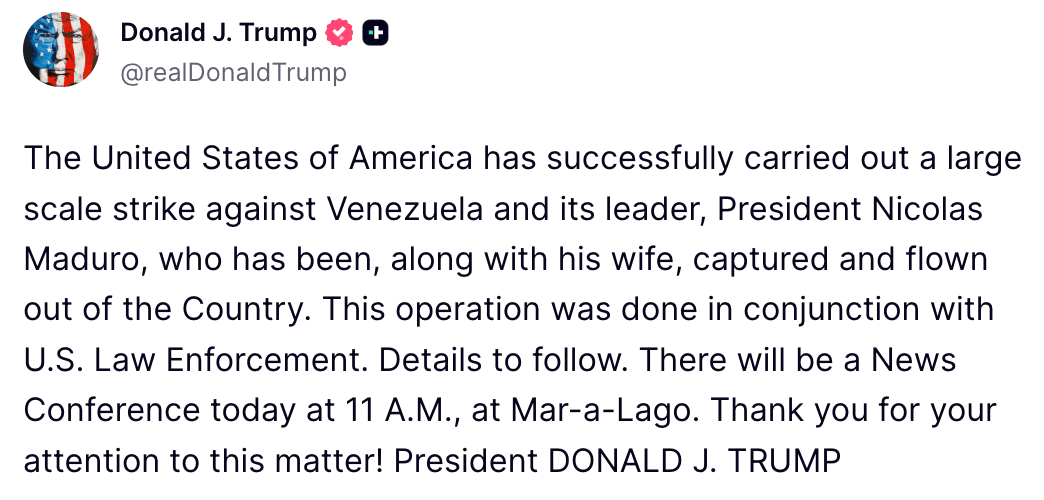
The Venezuelan government also announced that the United States is responsible for the attacks, and have declared a state of emergency. They have not announced who is in charge of the government.
The streets were silent, nobody left their home. There was no military movement, no police men on sight patrolling any vicinity.
At this moment, everybody is inside their houses: they are scared, not about what the U.S.A. will do, but about what the Venezuelan regime will do next.
Delcy Rodríguez, the person who proclaimed herself as Venezuelan Vice President, said on national television that Maduro and his wife, Cilia Flores, have been held captive and called on all guerrillas to take arms. For years “the colectivos”, people armed by the government, have killed and ‘disappeared’ civilians.
The future is as opaque as the Caracas’ sky on January 3rd.
The sun is rising and the Venezuelan population don’t know yet what is happening. We don’t know how many civilians or soldiers are injured or dead (or if there are any casualties at all). We just hope that the dictatorship can be toppled for good without Venezuelan blood.
Tim’s Take
After the paywall: Tim walks through the implications of this Trump administration attack.
Reporting from conflict zones all around the world is a costly endeavor. Upgrade your subscription now for full access — and to show that this sort of independent journalism IS worth it.