

Editor’s note:
The Counteroffensive would like to thank the readers in this video.
Your support makes this kind of reporting possible and gives meaning to the work we do every day. By being part of this community, you help ensure that critical human stories from Ukraine continue to be told.
We’re deeply grateful for your trust and wish you all the best in 2026.
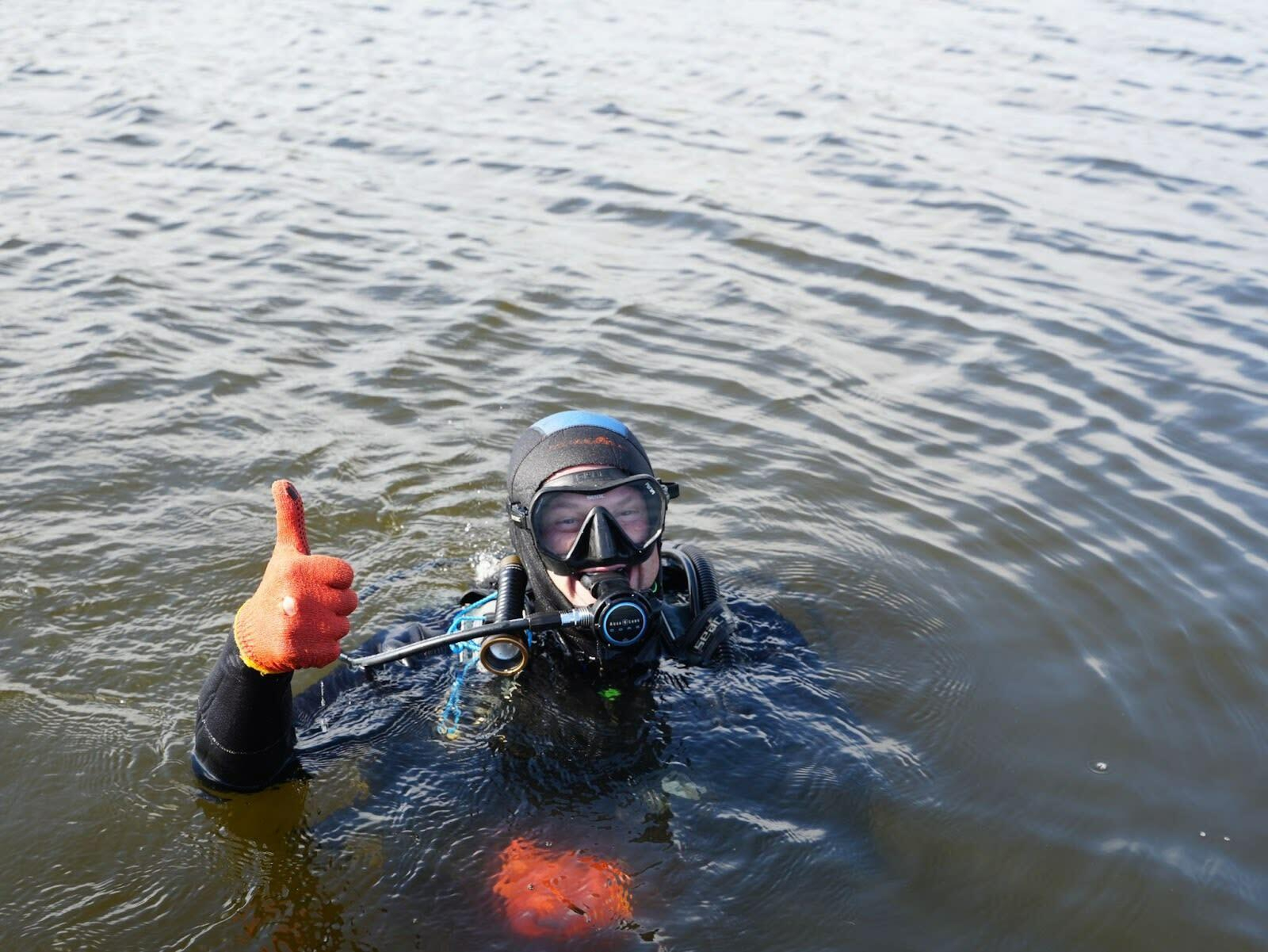
If Volodymyr Kozyriev added up all the time he spent in the water, sometimes under freezing temperatures, it would exceed seven days per year.
As the head of an underwater mine clearance group in the State Emergency Service of the Mykolaiv region, Volodymyr routinely dives into lakes and rivers to neutralize Russian explosives.
Epiphany, a holiday marked on January 6 to mark the baptism of Jesus Christ in the Jordan River, is not an exception for Volodymyr’s dives. While some ardent Christians in Ukraine dip into the cold water to cleanse their bodies and souls, ward off evil, stay healthy and secure longevity, Volodymyr and his colleagues are just doing their jobs, protecting military personnel and civilians from the looming Russian threat.
According to the UN, about 13,000 sq. km of Ukrainian waterways, including those in the Dnipro River, the Black Sea and lakes, could be contaminated with Russian explosive devices. To prevent them from going off sporadically, specialists from the State Emergency Service take a great risk. As of June, 2025, more than 500 rescuers were injured, and at least 105 died on duty due to Russian attacks.
For them, cold plunges are not an optional festive ritual, but an everyday, sometimes life-threatening job. Their silent and unnoticed heroism is what truly allows Ukrainians to mark holidays safely in the chaos of war.
Volodymyr began his career at the State Emergency Service unexpectedly.
His first dive was a training session. After years of watching other divers on his phone or a TV screen, looking around in the murky water himself felt both terrifying and exciting. Now he dives in the cold waters for work, while even some of the bravest Ukrainians would only dare to plunge for the Epiphany holiday.
“The water temperature can drop to 5, 2 or even 0 degrees [Celsius],” Volodymyr said.
To be ready for such extreme temperatures and challenging tasks at any time, Volodymyr has needed to develop his physical endurance and mental resilience. He and his team spend most days training. Divers are constantly analyzing their previous mistakes to improve their teamwork and adjust to new equipment. This is crucial in order to adapt back to severe conditions. The working schedule at the Emergency Service is also intense, as the rescuers need to stay on call over weekends and holidays.
As stressful as it is, Volodymyr finds comfort in diving. He describes feeling like he is going to a completely different world where everything is much more peaceful.
“There is no one there, it is quiet. You are completely cut off from the modern world. There is no phone, and no one can call and distract you. When we come to some new places with clear water and a good view, it is like paradise for us.”
This feeling of serenity parallels what people are trying to find when they jump into the chilling water on Epiphany, which is one of the most important winter holidays in Ukraine.
Although the cold plunge tradition is not widely observed nowadays, it certainly lives on in Ukraine. The name ‘Epiphany’ was first used in a written source in 1148, but the custom itself was kept in all regions of Ukraine up to the beginning of the 20th century, marked by a civil war in Ukraine and establishment of the Soviet Union.
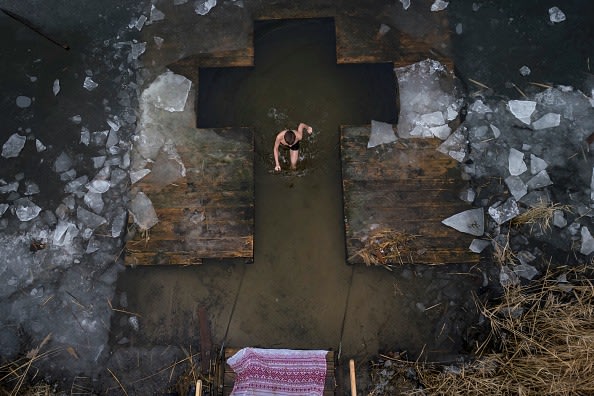
On January 6, the water is said to become “holy.” If it freezes over, observers form a cross-shaped hole in the ice, which might come from the Ukrainian name of the holiday, ‘Vodokhreshcha’. Derived from voda, which means ‘water’, and khrest, ‘a cross’, it means baptism in the holy water.
In traditional celebrations, early in the morning, everyone tried to drink water from a nearby river or lake as a remedy for future illness. Girls used to wash their faces in it to get rosy cheeks and preserve their beauty. Swimming in the cold water on Epiphany was reserved for the bravest, and mostly for the young.
People who participated in theatrical performances on the holiday of Malanka and Vasyl (see our story on that) also did cold plunges on Epiphany to wash away evil spirits they might have accidentally summoned during their plays.
Today, some people still dare to jump. Among them are celebrities, politicians and the mayor of Kyiv, Vitalii Klitschko. Even the former President of Ukraine, Viktor Yushchenko, plunged in years past.
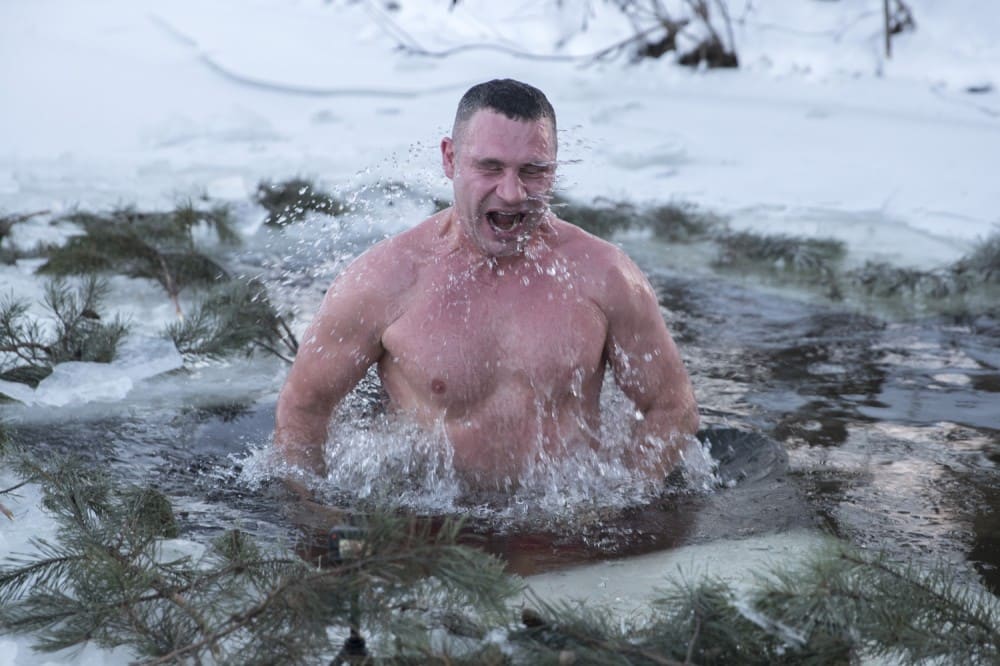
Volodymyr is wary about the tradition, and only vaguely remembers his father plunging on Epiphany. He warns that diving might be unsafe and cause sudden cramps, especially for people who are not used to it. Even professional divers don’t jump into the cold water unprepared.
To search for and neutralize mines in winter, Volodymyr wears a thick wetsuit, which ensures that his skin does not touch the water. Still, it confines his movements and cannot protect him entirely from the cold.
“In winter, we spend less time underwater, but you can get any disease. With some of them, like pneumonia or sinusitis, you cannot work in the water at all,” he said.
During the war, very few people dive to celebrate Epiphany as mass gatherings are forbidden by martial law. On the flip side, the Emergency Service performs increasingly challenging tasks.
As Volodymyr explains, an explosion in less than one kilometer next to divers may be deadly, even underwater. He faces further challenges when he has to deal with unfamiliar equipment and invent creative solutions to disarm it.
“Many explosive devices were not used before, and we were not taught such methods. These are used specifically against divers, against any swimming equipment or armored equipment crossing rivers. When it is in the middle of the river, we can’t get to it by boat because of the big waves. Sometimes we use robotic systems or drones to liquidate it.”
Each mission is carried out by at least 4 people, including a car driver, two divers, and a person to support and assist them on the ground. The longest missions could last for weeks.
Unexploded mines or missiles usually take the most time to extract and often require specific equipment and precise scans of the sea floor.
“Some of it is not even invented yet,” joked Volodymyr.
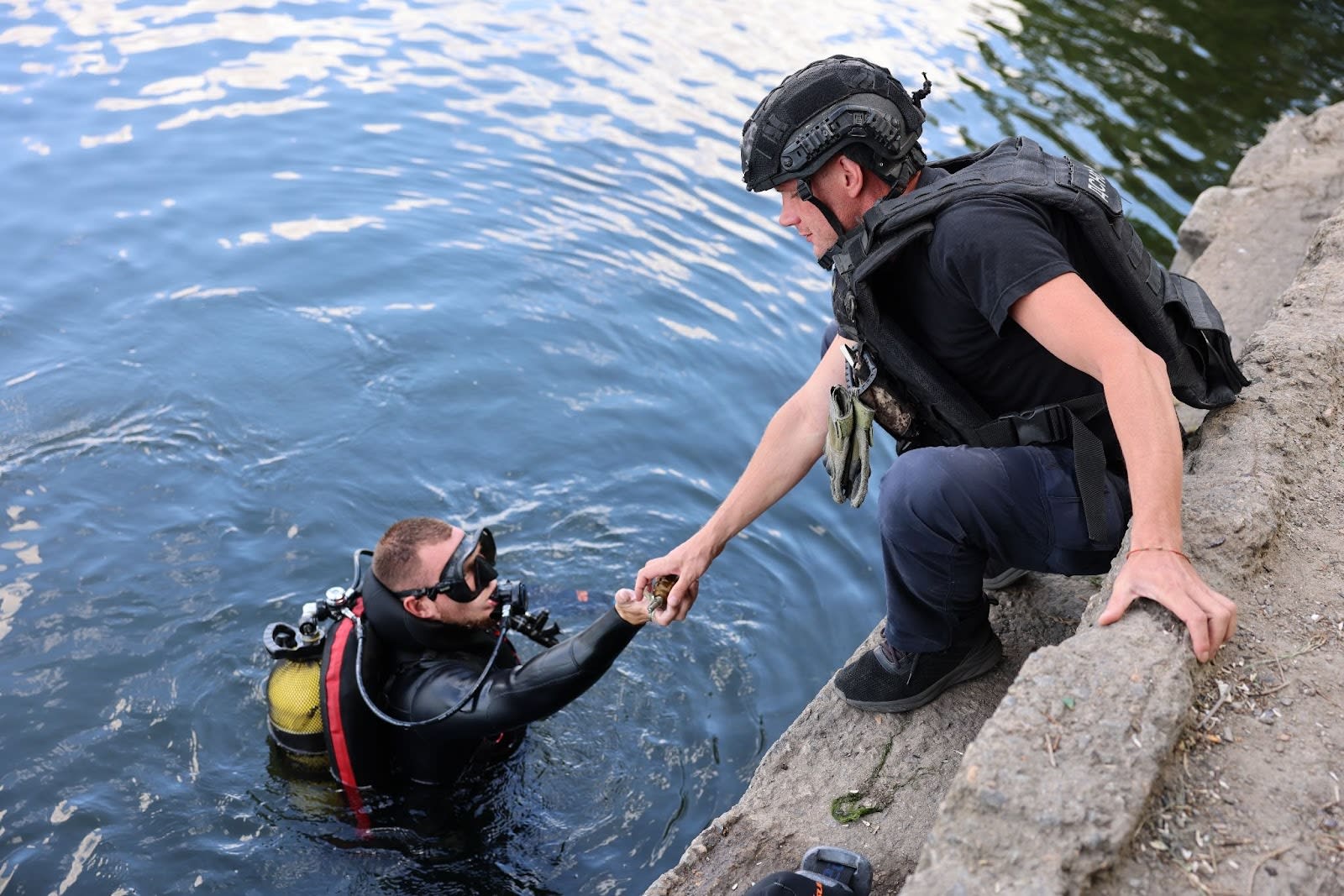
Volodymyr said life-saving tasks and searching for bodies are the hardest for him.
“The most difficult thing is when you come to look for a dead child,” he said. I remember when two boys drowned... Not everyone can take that,” he said.
Many calls to the Emergency Service are made by locals who spot suspicious objects in the water. For Volodymyr, one trend is disturbing and relieving at the same time: after almost four years of war, false alarms have grown rare. People have learned to recognize different kinds of explosive devices and self-monitor their requests for help.
Still, it’s better to be safe than sorry, he said, which can lead to some funny cases:
“There was a time when we came to remove an anti-personnel mine, but it turned out to be a drinking trough for little ducklings. It was just stuck in the ground, slightly trampled, and they thought it was a mine.”
Volodymyr doesn’t celebrate Epiphany himself, but when he protects Ukrainians from explosives underwater, he helps to preserve this tradition and the Ukrainian way of life in a broader sense.
Editor’s note:
The Counteroffensive would like to thank the readers in this video.
Your support makes this kind of reporting possible and gives meaning to the work we do every day. By being part of this community, you help ensure that critical human stories from Ukraine continue to be told.
We’re deeply grateful for your trust and wish you all the best in 2026.
NEWS OF THE DAY:
By Anastasiia Kryvoruchenko
Good morning to readers; Kyiv remains in Ukrainian hands.
ZELENSKYY-‘COALITION OF THE WILLING’ TALK ON SECURITY GUARANTEES: Today, Zelenskyy and Western leaders will meet in Paris to define post-war security guarantees for Ukraine, AP reported. U.S. representatives — Steve Witkoff and Jared Kushner — will attend the meeting.
A key topic of the meeting will be securing U.S. approval for deploying American troops in Ukraine, as well as other forms of assistance within the framework of security guarantees.
ZELENSKYY APPOINTED CANADIAN POLITICIAN AS ECONOMIC ADVISOR: President Zelenskyy has appointed Chrystia Freeland, former Deputy Prime Minister of Canada, as an advisor on post-war reconstruction, NYT reported. She will provide consultations on rebuilding in the event that negotiations succeed and peace is reached.
Freeland’s appointment to this role comes amid Trump’s push for U.S. participation in reconstruction.
U.S. TO SEIZE VENEZUELAN OIL TANKER UNDER RUSSIAN FLAG: The U.S. plans to seize the tanker ‘Marinera’, which is carrying Venezuelan crude oil under the Russian flag, CBS reported. The ‘Marinera’ is listed as having departed a port in Sochi on the Black Sea coast.
The Russian government has requested that the U.S. refrain from any attempt to seize the tanker. Sanctions and strikes on Russia’s oil infrastructure have dealt a painful blow to the Russian economy which is heavily reliant on the energy sector.
DOG OF WAR:
Nastia met this pup while having coffee with a friend and enjoying one of the few sunny days in Kyiv. The dog’s outfit matched the weather perfectly.

Stay safe out there.
Best,
Oleksandra