

Editor’s note:
We work during a difficult and exhausting time, with full-scale war, air-raid alerts, and blackouts. Often without electricity or internet, but with an unwavering sense of responsibility to document key events of the war and public life.
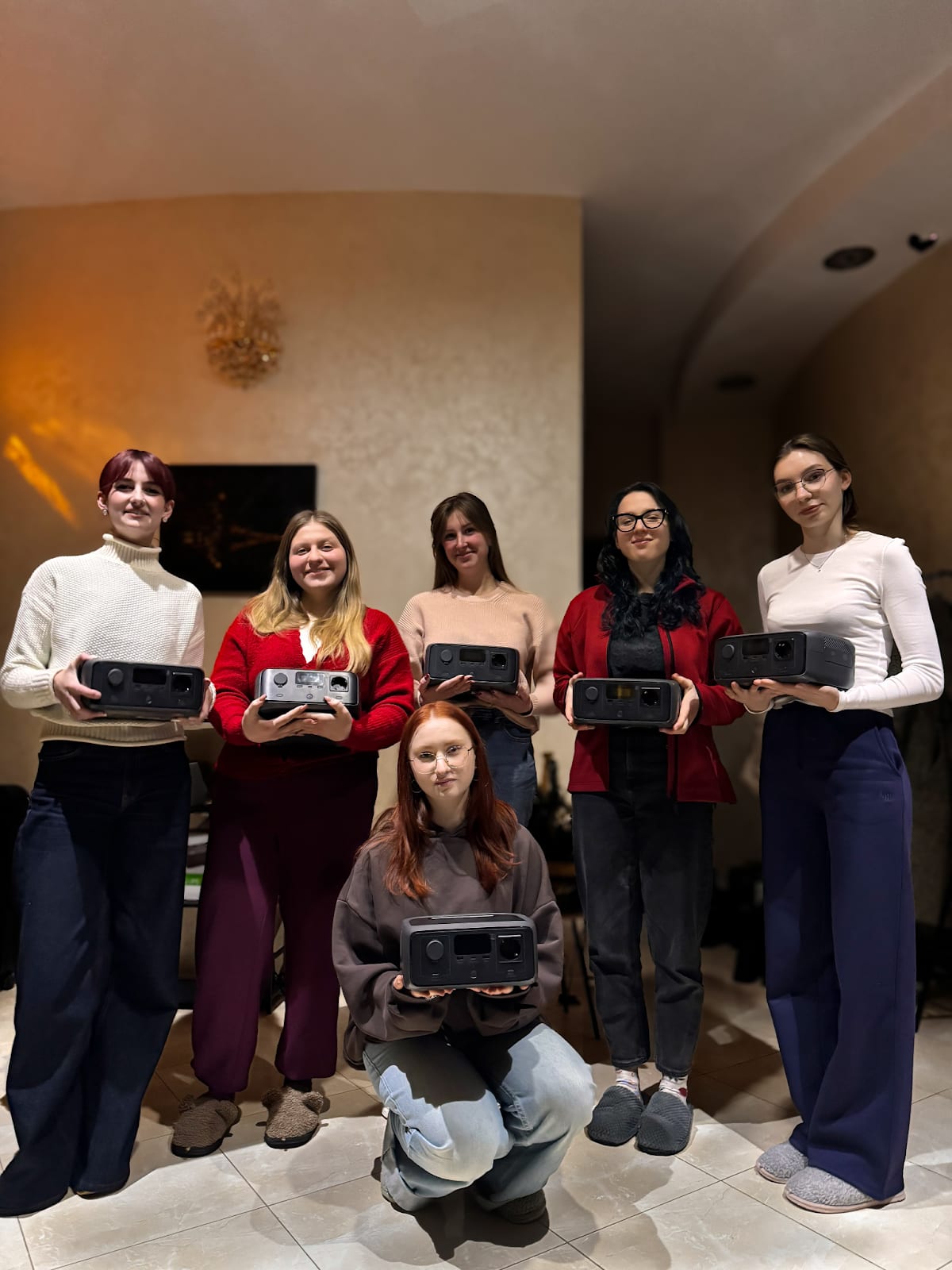
We are sincerely grateful to our subscribers for their trust and support. Thanks to your donations, we were able to purchase EcoFlows, which allow our colleagues to work under any conditions.
Independent journalism is impossible without its community. Support us with a subscription and stay with us.
“We used to sit together until late at night,” recalled Ivanna, “and then we would bring phones, lamps, torches – anything that could illuminate the scene for us to [be able to] talk.”
Ivanna Mykhailenko navigates the world without sound, relying on her eyes to communicate. For her, losing access to electricity is catastrophic, especially at night.
Since Russia intensified its attacks, people have had to adjust to a new, completely unpredictable lifestyle. In 2025 alone, Russia launched more than 4,500 drones and missiles on Ukrainian energy infrastructure, disrupting not only electricity but also water supply and heating.
On January 7, when energy infrastructure in the Dnipro and Zaporizhzhia regions was attacked, most cities in those regions went completely dark and silent for several hours. They lost access to water, public transport, reliable phone and internet connections, or even air-raid alert signals.
People with hearing loss are even more vulnerable to such attacks. Not only do long blackouts leave them without a way to charge hearing aids, it also deprives them of ways to communicate and react to air raid alerts.
In Ukraine and elsewhere, wars reveal the same truth: what is merely an inconvenience for most becomes a matter of survival for people with disabilities.
Born deaf in a ‘hearing’ family, Ivanna learned to talk and lip-read during her childhood.
“We had a rule — Mom and Dad didn’t use gestures at all. They taught me to speak, to pronounce words, and to read, so I understood them. I also spoke only in words. My voice is a little bit unusual, but everyone in the family understands my speech,” Ivanna said.
Although Ivanna mastered sign language at school, none of her relatives use it themselves. Still, they find ways to make her feel their affection. Ivanna’s heart melted when her aunt secretly learned a few phrases in sign language to wish her a happy 24th birthday.

Unfortunately, the world beyond her immediate family proved itself to be more challenging.
As a deaf person in Ukraine, she faced roadblocks — from finding a job, despite a degree in law, to receiving medical treatment.
“Some doctors shout in our ear, and we have to shout back. Others might just send me to the back of the line, so they don’t have to waste so much time on deaf people,” she recalled.
In the first days of the full-scale invasion, there were cases where Ukrainians with deafness watched the chaos around them in confusion because they couldn’t hear the sirens — realizing that the war had begun only when they saw explosions.
In the first 8 months of the war, at least 6,000 people with hearing loss left Ukraine for safety, according to the Ukrainian Society of the Deaf. 9,000 more became internally displaced.
Ivanna was living alone in a flat in Kyiv when she woke up to a vibration. At around 6 o’clock, she thought someone might have called her by mistake, but her phone continued to frantically shake. Ivanna’s mother was trying to reach her to tell her that the war had begun.
“When I opened the door and saw people running, saw the panic among people on the street, I did not understand,” Ivanna said.
Now, Ivanna keeps her phone close to her while she sleeps so as not to miss out on potentially lifesaving updates.
She remembers spending a night in the basement of her building with a woman who suddenly flinched at the sound of an explosion.
“She said it was very loud, but I didn’t blink an eye,” Ivanna remembered.
After an attack on energy infrastructure in a certain area, households are divided into several groups, which only have electricity during certain hours. This method is intended to ease the strain on the energy system while it is being repaired. The worse the condition of the energy system state is, the longer the cuts are.
Ivanna’s first blackout was on her 22nd birthday.
At the time, she was preparing for her final exams. On long autumn nights, she navigated her apartment and studied for her finals with a small battery-powered flashlight. Despite the dark, reading had become Ivanna’s source of comfort amid the uncertainty.
Still, her new reality didn’t allow excuses. She bought a power supply for the internet and a charging station to keep her phone and laptop alive.
When the screen illuminates Ivanna’s face, she can even send a message in sign language on Telegram.
“To see around and communicate, I use my laptop screen or a flashlight on my phone for lighting,” Ivanna said. “Technology becomes my eyes.”
Keeping her phone charged might seem trivial, but for some people with hearing loss, it’s their means of relating to the world. Using a smartphone, for example, people can turn written text into speech and vice versa.
“In fact, there are a lot of such functions built into the phone. Often, people don’t even know what they carry in their pockets. When we conduct training for people who have lost their hearing, we try to tell everyone about these settings. The more people know, the more people can improve their lives immediately,” said Anastasiia Demchuk from the NGO Talk!, which creates software solutions for people with disabilities.
Often, deaf people still depend on light to call emergency services.
“When it is urgent, I use the sign language translator,” Ivanna said. “It’s convenient to call an ambulance, the police or the fire department. I can add an interpreter to a video call via the app, and they help me voice my needs to a hearing person on the other side.”
On the hardest days, blackouts in Kyiv last up to 18 hours. Though Ivanna has never needed to use one, about 13,500 ‘Spaces of Resilience’ operate across the country where people can charge their phones and connect to the internet for free in case of an emergency.
Attention to the deaf and hard-of-hearing community in Ukraine is growing. Blast injuries, which often lead to severe hearing loss, have become one of the most common traumas among military personnel, according to Talk!

Despite the danger, Ivanna doesn’t always get herself to safety during shelling — not out of bravery, but for reasons she can’t control.
The air raid alerts that most Ukrainians get on their phones sound a loud ding, inaudible to the deaf. They are forced to use other apps which vibrate and activate a camera flash.
For Ivanna, deaf people are a close-knit community with their own slang unfamiliar to the hearing, unique sign names, and unusual “superpowers,” as she says. One of Ivanna’s friends can recognize a person just by the way their shadow moves.
Despite all the hardships Ivanna faces during blackouts, she tries to make light of her situation.
“Power cuts can stop any quarrel between deaf people,” she jokes. “In the dark, we can’t see what our opponent has to say.”
Editor’s note:
We work during a difficult and exhausting time, with full-scale war, air-raid alerts, and blackouts. Often without electricity or internet, but with an unwavering sense of responsibility to document key events of the war and public life.
We are sincerely grateful to our subscribers for their trust and support. Thanks to your donations, we were able to purchase EcoFlows, which allow our colleagues to work under any conditions.
Independent journalism is impossible without its community. Support us with a subscription and stay with us.
NEWS OF THE DAY:
By Myroslava Tanska-Vikulova
Good morning to readers; Kyiv remains in Ukrainian hands.
UKRAINIAN PILOTS HAVE REWORKED F-16 TACTICS FOR WAR WITH RUSSIA: One of the first Ukrainian F-16 pilots stated that Western training did not correspond to the realities of war with Russia, so pilots had to develop their own combat tactics. According to him, the conditions of full-scale war, saturated air defense, and combat operations near the front line forced Ukrainian F-16 pilots to adapt. This has drawn attention from Ukraine’s Western partners, who are in their own period of rearmament and military preparation.
TRUMP APPROVES SANCTIONS AGAINST BUYERS OF RUSSIAN OIL: President Trump gave the green-light to Republicans in Congress to advance a bill on so-called secondary sanctions against countries that buy Russian oil including China, India, and Brazil, Senator Lindsey Graham said. Meanwhile, President Zelenskyy said that he believes it is possible to end Russia’s full-scale war against Ukraine in the first half of this year, emphasizing that this week’s negotiations in Paris were an important step forward.
THE EU IS ACCUSED OF FINANCING WAR THROUGH RUSSIAN LNG IMPORTS: The Kremlin earned over $8.4 billion from the European Union in 2025 via exported Russian liquefied natural gas. This comes despite Brussels’ promise to completely ban Russian LNG by 2027. According to NGO Urgewald, supplies from the Russian Yamal project to EU ports still reach over 15m tonnes, and Europe’s share in the global export of the Yamal gas has even increased in that last year.
DOG OF WAR:
Zoriana met this cutie pie on a train platform while returning from Lviv, a city in western Ukraine, to Kyiv. The train was delayed by four hours, and they waited patiently together. Thanks to his fluffy ‘coat,’ he didn’t get too cold — unlike Zoriana.

Stay safe out there.
Best,
Oleksandra