
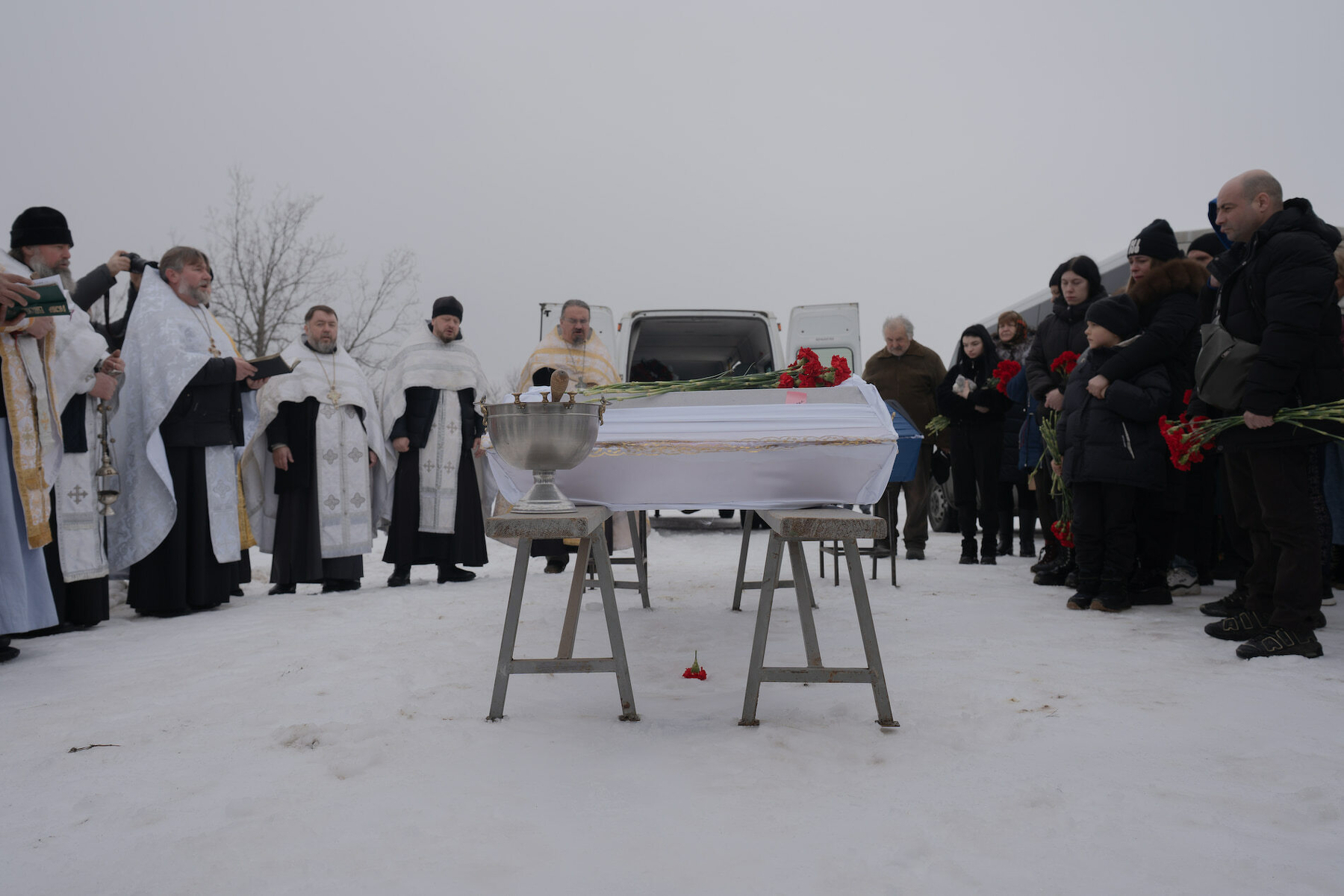
UKRAINE, SKOVORODYNIVKA — The biers for the ceremony were set up in advance.
First, funeral workers carried out Hryhorii Shykula’s coffin, the largest of the four. He was 34 when the Russian kamikaze drone hit their new family house in Bohodukhiv and killed him and his children, about two years after a Russian mine explosion took his foot. Next, Vladislav and Ivan’s twin coffins were brought out, both wrapped in the deep blue fabric like their father’s. They were two years old. Myroslava’s coffin is the last. It’s small and covered in white. She was born on Jan. 1, 2025.
At least a hundred people attended the funeral on Feb. 13. Nine priests came from different parishes of the Zolochiv community of Kharkiv oblast, adjacent to the border with Russia and constantly hit with their drones and glide bombs.
“On Feb. 11, we buried a family — Svitlana and her 10-year-old son Mykhailo. And now, this family has died. They slept in the house they bought, the house they’ve dreamed about. And it became fatal for them,” said Father Stephan to Gwara, his grey eyes wet. Today, along with other priests, he will perform a funeral service in Russian, as it’s often held in Ukraine Orthodox Church of the Moscow Patriarchate*, but speak the words of comfort to friends and relatives of Hryhorii’s family in Ukrainian.
Olha Krivohub, 35, couldn’t come to the funeral of her husband and children — 35 weeks pregnant, she was hospitalized with a head injury after the attack. During that night on Feb. 11, she left Hryhorii with the kids while they played and fell asleep on another couch. The Russian drone strike threw Olha on the roof. A neighbour had found her and carried her away, burnt and concussed and crying for her sons. Then, the flames spread after the strike reached the gas pipes and triggered another explosion.
“She is in pain,” Oleksandra, Olha’s sister-in-law, said to the question of Olha’s current state. She was trying to hold her tears in long pauses between words. “The entire world, all warmth was taken away from her. Only hurt remains.” Olha hoped for the war’s end, Oleksandra shares, and named her daughter to honor this feeling. “Myroslava,” translated from Ukrainian, means ‘glory to peace’. “The war isn’t over. The war took them away.”
“Who could have raised their hand and dared to kill this family? I can’t imagine. They are not warriors… They are inhuman,” Viktor Kovalenko, the head of the Zolochiv regional military administration, spoke at the service. His voice was rough, cracking with emotion. Ukraine’s soldiers who serve at the frontline in the northern Kharkiv region “will avenge” the family, he added. He knelt near the twins' coffins and put his hand on one of them. “Lord, take them to you.”
Anatolii Yeliseiev, starosta of Hryhorii’s community, said both Hryhorii and Olha wanted a big family, like the one they had growing up. After Hryhorii’s injury on the battlefield, he went through hospital, subsequent rehabilitation, and then finally returned to his wife and sons waiting for him. “All of them wanted to live.”
They didn’t even manage to get the official documents that they owned the new house, Yeliseiev added. Spent a single night there, and the next night, Russian drones hit Bohodukhiv.
The priests read psalms. They called the family “slain innocents” (nevynnoubiienni, “невинноубієнні” in Ukrainian). They read from Thessalonians: that the dead in Christ will rise first. “After that, we who are still alive and are left will be caught up together with them in the clouds to meet Lord in the air.”** The Russian Federation destroys families like this one, Father Stepah said. “These families couldn’t threaten anyone.”
Ivan, Hryhorii’s brother, was the first to approach the dead to say goodbye. According to starosta, Hryhorii had followed his example to go to the army. Both of them were demobilized. Ivan laid red carnations on the blue of his brother's coffin and pressed a kiss to it.
Other soldiers who came to the funerals didn't speak much. They stood in small groups, sticking to the edges of the crowd. Making way for others.
“They were happy, fun, friendly, what can I say?” one of Hryhorii’s brothers-in-arms says, after refusing to share his name. “He only did good.”
The man and his children were being buried next to Hryhorii and Ivan’s father. The post-it notes are put onto coffins. Each with the gentle, short version of the name of the person inside written on it: a clue for funeral workers. Priests put holy water into the graves. Asked everybody to throw a handful of freshly dug earth into the graves next.
The edges of graves were slippery, the snow around them overtaken with a thin, icy layer. Ivan went first again. Threw his four handfuls of soil. Like many after him, he used the snow to wash the cemetery from his hands.
From where the family’s house was located, one can see half of the city of Bohoduhiv. Almost four days after the Russian drone hit here, what remains of the home Hryhorii and Olha wished for still smells like things burnt and ashen.
Workers are already rebuilding the neighbouring house. Installing a new carcass for the roof. Covering it with a protective layer of film to guard against the rain and snow. They're shouting instructions and precautions to each other, loud in the quiet of the street.
Halyna, a woman who lived in the house, tells Gwara that, seconds before her home was destroyed, her cat bothered her and she went to let him go outdoors. She believes that saved her from a Russian drone. Halyna didn’t get to meet her new neighbours properly. They had just moved in at the beginning of last week and, a few days later, she saw their house burn down.
Photo credit: Vessel for holy water with aspergillum in front of the line of coffins standing on the biers between the priests and those who gathered on the funeral of Hryhorii Shykula and his three infant children, killed by a Russian drone attack on Bohodukhiv. Feb. 13, 2026 / Gwara Media, Polina Kulish
* Ukrainian Orthodox Church of the Moscow Patriarchate (6% of respondents to a poll in Ukraine go to UOC-MP’s churches). It was banned in 2024.
** (1 Thessalonians 4:17).
Read more
- “Train of invincibility” keeps Kharkiv rail passengers warm during coldest winter since Russia’s full-scale invasion
- “I followed the order.” Kharkiv court sentences Russian soldier who killed Ukrainian POWs in Vovchansk to life imprisonment
The post “Only hurt remains” — Bidding farewell to veteran, his three children killed in Russian drone attack on Bohodukhiv appeared first on Gwara Media.