
Recent surveys show that most Germans favor increasing aid to Ukraine. However, this sentiment is not uniform. Which parties’ voters are most supportive of Ukraine’s struggle, and which believe in Putin’s peaceful intentions?
According to a survey conducted on February 5-6 by INSA on behalf of Bild, 52% of Germans believe that Western countries should expand assistance to Ukraine in order to push Putin toward peace negotiations. Of these, 28% support both financial and military assistance, while 12% each believe that either military or financial assistance should be increased. Meanwhile, 35% of respondents oppose increasing aid to Ukraine, and 13% have not formed an opinion on the issue.
However, support for Ukraine varies by respondents’ party affiliation. Voters of the SPD (Social Democratic Party of Germany), the Greens, and the CDU (Christian Democratic Union), led by current Chancellor Friedrich Merz, are the strongest supporters. The lowest levels of backing for Ukraine are found among the traditional “Putin sympathizers” (voters of the Sahra Wagenknecht Alliance (BSW) and Alternative for Germany (AfD)) at 35% each.
Figure 1. Percentage of German party voters who support increasing aid to Ukraine, February 2026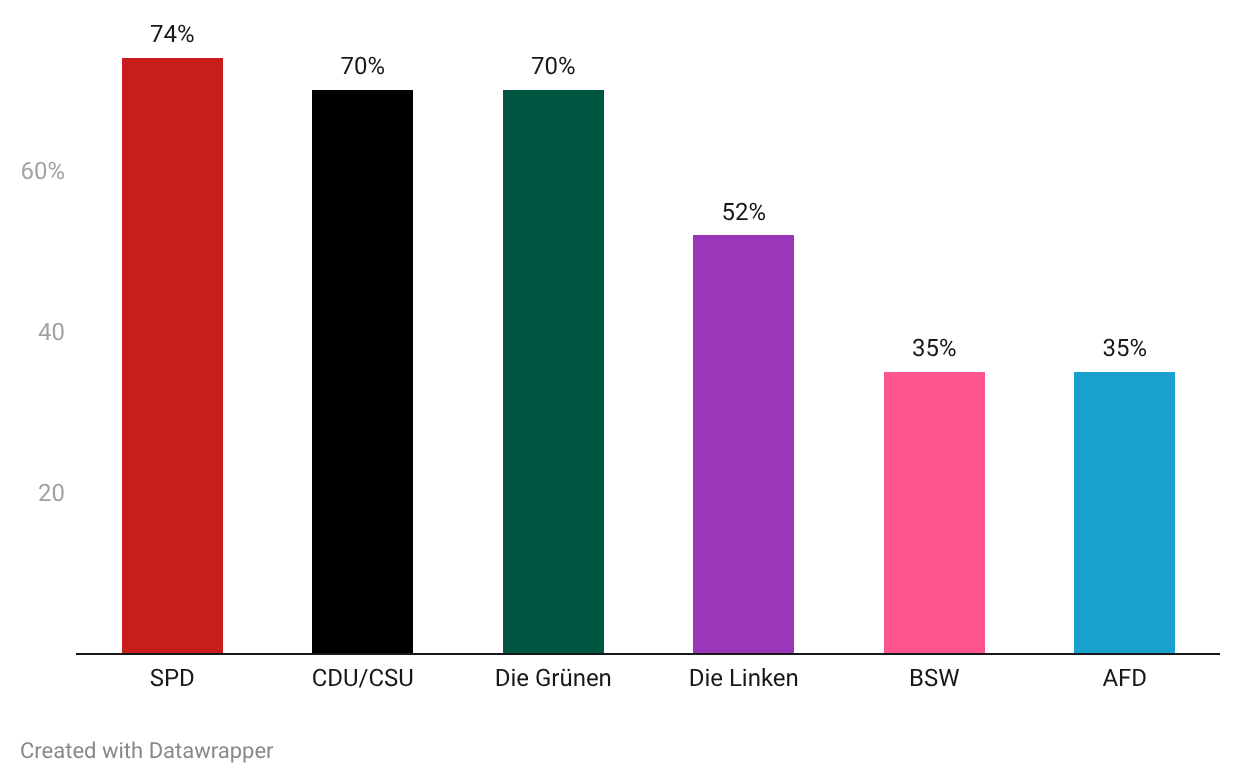
Source: Bild survey
In the Omnibus Politik survey conducted in July 2025 by YouGov, one of the questions asked what Germany’s position should be at the current stage of the Russia-Ukraine war. Respondents were offered two answer options: (1) Germany should advocate for peace negotiations, even if this results in Russia gaining control over some Ukrainian territories, and (2) Germany should provide military aid to Ukraine until Russia fully withdraws from Ukrainian territories, even if this means the war will continue. Overall, 47% of respondents support providing military assistance to Ukraine until the full liberation of its territories, while 32% lean toward a peace agreement at the cost of territorial concessions. Another roughly 20% did not choose either option or answered “don’t know”.
Greens voters are most supportive of Ukraine’s struggle. More than 60% of them believe Germany should provide military aid to Ukraine until all occupied territories are liberated, and only 19% support ending hostilities at the cost of territorial concessions. The situation is exactly the opposite among supporters of the Sahra Wagenknecht Alliance and Alternative for Germany: 75-80% believe Ukraine should concede territory in exchange for a peace agreement, and fewer than 10% believe Germany should continue backing Ukraine’s struggle. The views of voters of Merz’s party (CDU) are almost evenly split – 40% to 42%. Among SPD voters, a majority consider supporting Ukraine in its fight for its own land to be the right course of action – 49% versus 33%.
Figure 2. Percentage of German party voters who support territorial concessions by Ukraine to achieve a peace agreement and those who support continued military aid to Ukraine until the full liberation of occupied territories, July 2025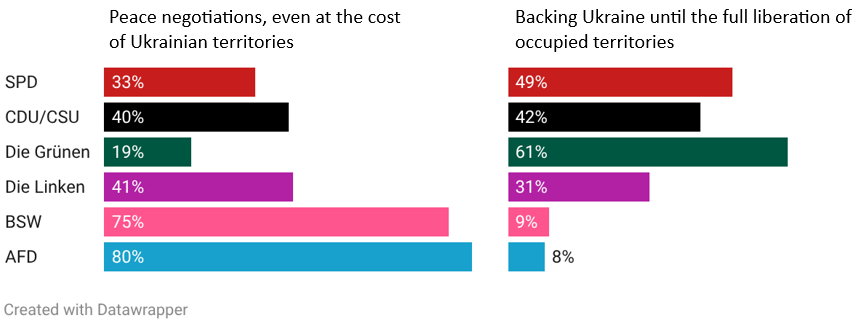
Source: YouGov survey
At the same time, in a December survey by IP-Forsa-Frage on Germany’s foreign policy priorities, “support for Ukraine” fell by 10 percentage points (from 17% in May 2025 to 7% in December 2025), dropping to last place, behind “developing relations with countries of the Global South”. Meanwhile, the importance of “limiting the influence of authoritarian states such as Russia and China” increased by 8 percentage points – from 20% to 28%. Germans consider the most important foreign policy priorities to be “strengthening unity in Europe” (54%) and “increasing Germany’s defense capabilities” (37%).
Figure 3. Foreign policy priorities according to German respondents, December 2025
Source: Internationale Politik survey
At first glance, it may seem that Germans are losing interest in Ukraine and its struggle against the aggressor. However, the reason may be different – Germans may have stopped perceiving Russia’s war against Ukraine as a local problem and financial and military aid as merely “supporting a victim of aggression”, and instead realized that this threat exists for them as well. Therefore, the focus has shifted from “support for Ukraine” to “countering Russia”, “European unity”, and strengthening their own defense capabilities.
Photo: depositphotos.com