
Following the snap Bundestag elections held in February 2025, Germany’s political landscape changed markedly. Friedrich Merz’s government replaced Olaf Scholz’s coalition, prompting a reassessment of numerous domestic and foreign policy initiatives. In this article, we analyze how German assistance to Ukraine has changed, how Berlin is responding to economic challenges and populist pressure, and which security issues are now at the top of the agenda.
The 2025 elections reflected deep fragmentation in German society. The victory of the Christian-conservative CDU/CSU alliance, with 28.5% of the vote, confirmed voters’ demand for stability and a return to conservative values. However, the Christian Democrats’ triumph was overshadowed by the unprecedented success of the Alternative for Germany (AfD), which secured 20.8% of the vote, doubling its result compared with 2021. This forces Chancellor Merz to navigate between supporting Ukraine and the risk of further radicalizing the electorate, particularly in the eastern Länder.
The exit of the Free Democratic Party (FDP) from parliament and the historically lowest result of the Social Democratic Party of Germany (Sozialdemokratische Partei Deutschlands, SPD) significantly narrowed the range of potential coalition partners. This made the Grand Coalition (CDU/CSU and SPD) effectively the only viable option. The new government is forced to operate under conditions of a budget deficit and the United States’ return to isolationism. Under these circumstances, support for Ukraine is evolving: it is becoming not only a matter of solidarity but also a strategic necessity for strengthening European security and a driver of Germany’s defense industrial sector.
Political landscape
The election results created a unique and highly tense atmosphere in the 21st Bundestag. Although the CDU/CSU received a mandate to form the government, the opposition changed significantly: it became more radical and anti-establishment.
Figure 1. Distribution of seats in the Bundestag, 2025 and 2021
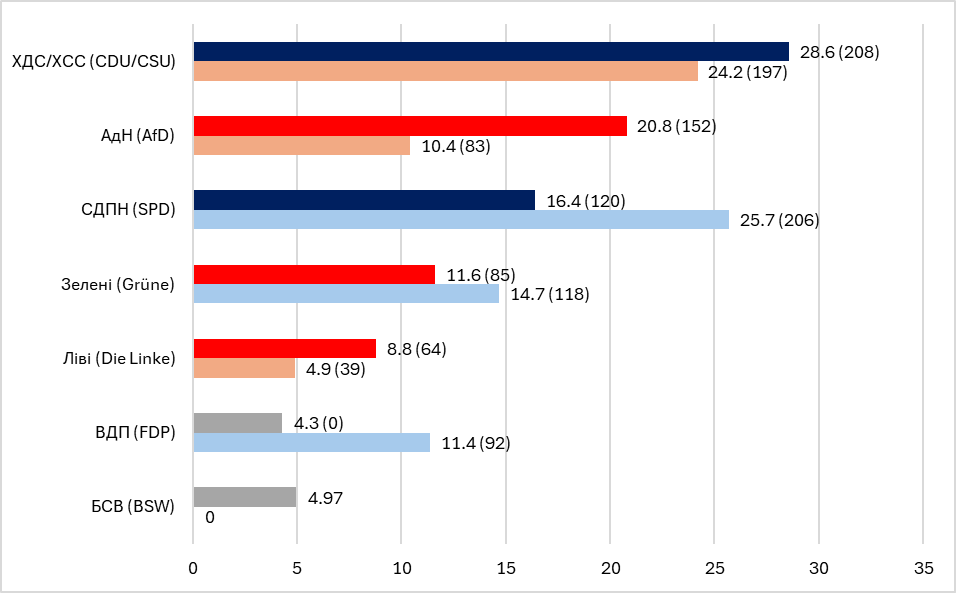
Source: Federal Returning Officer. Note: Blue (2025) and light blue (2021) indicate parties that formed the governing coalition; red (2025) and orange (2021) indicate opposition parties; gray indicates parties that did not enter the Bundestag.
Political parties in Germany (2025)
- Christian Democratic Union and Christian Social Union (CDU/CSU) – center-right party (conservatives). The main political force in the new government.
- Alternative for Germany (AfD) – far-right party. Advocates nationalism, Euroscepticism, and strict limitations on migration.
- Social Democratic Party of Germany (SPD) – center-left party. Traditionally focused on social protection and workers’ rights. The party of Olaf Scholz.
- Alliance 90/The Greens (Grüne) – center-left party. Focuses on environmental policy and human rights.
- Sahra Wagenknecht Alliance (BSW) – a distinct political force: left-wing on economic issues but conservative on migration and cultural issues.
- The Left (Die Linke) – left-wing party. Advocates radical social justice and criticizes Germany’s participation in NATO.
- Free Democratic Party (FDP) – center-right (liberal) party. Advocates for business interests and the minimization of state intervention in the economy (following the 2025 election, it did not enter parliament).
The presence in parliament of a powerful AfD and the Left Party bloc, which together secured more than one-third (34%) of the seats (having received 29.6% of the vote and additionally benefiting from the proportional redistribution of seats from parties that did not enter parliament), creates constant pressure on the government. Each aid package and funding allocation becomes an object of criticism from opponents of Ukraine and a pretext to accuse Ukraine of «money laundering and financing terrorism» at the expense of German taxpayers. This forces the Merz administration to exercise extreme caution in its public communications and to seek alternative financing mechanisms that would not provoke the electorate, particularly through European instruments. Another cause for concern is the success of the newly formed Sahra Wagenknecht Alliance (BSW) in the eastern Länder, a party known for its pro-Russian and Eurosceptic positions. It secured 10-12% of the vote in most eastern Länder, although it did not enter the Bundestag.
Merz: campaign promises and realpolitik
During and after the election campaign, Friedrich Merz positioned himself as the antithesis of former Chancellor Olaf Scholz. His statements that «Putin understands only the language of force» and his calls to mobilize financial resources to «secure Kyiv’s military resilience» raised expectations of a fundamental shift in Germany’s policy of supporting Ukraine.
At the beginning of his term as chancellor, Friedrich Merz stated that Ukraine has the right to strike military targets on Russian territory. One of the first significant decisions of the new government was the official removal of restrictions on the range of weapons supplied by Germany. This marked a significant departure from the escalation management policy pursued by Scholz.
However, Merz soon encountered the realities of coalition governance and political ambitions that sometimes contradict both common sense and national security considerations.
The most illustrative example of the gap between expectations and reality was the protracted debate over the Taurus cruise missiles. While in opposition, Merz repeatedly called for their transfer; however, after becoming chancellor, he did not authorize their delivery. In May 2025, the transfer of Taurus remained within the realm of possibility, but it has not taken place to date. The chancellor has communicated very cautiously with the German public and emphasized that Germany cannot become a party to the war. However, Germany plans to develop its own long-range strike capabilities under the Taurus NEO program.
Economy
The economic situation in which the Merz government is operating is highly unfavorable. After a two-year recession (2023-2024) and stagnation in 2025, Germany entered 2026 with an official GDP growth forecast of 1.0%. This poses an extremely difficult challenge for the government: how to finance the largest war in Europe since 1945 without increasing social tensions?
In a published article, Friedrich Merz proposed an interest-free loan mechanism for Ukraine totaling nearly €140 billion, to be repaid only after Russia compensates Ukraine for the damage it caused. Until then, frozen Russian assets would serve as collateral for the loan.
In December 2025, the European Commission approved €90 billion in funding for Ukraine under this mechanism and proposed changes to budgetary rules that would allow loans to Ukraine to be issued through the budget headroom mechanism. On February 4, the European Council approved the allocation: €30 billion to the macro-financial assistance (Ukraine Facility) and €60 billion to support investments in the defense-industrial sector. In effect, the EU borrows these funds on financial markets under government guarantees. This represents an optimal solution for Berlin, as the assistance is financed at the EU level, allowing these amounts to be excluded from Germany’s national debt and avoiding violations of debt limits.In December 2025, Germany adopted its 2026 budget, which increased assistance to Ukraine to €11.5 billion – equivalent to 2.2% of total budget expenditures and 0.2% of the country’s GDP. At the same time, an unprecedented €108.2 billion was allocated for Germany’s own defense, amounting to 2.4% of GDP. The trends are positive; however, behind these record figures lies institutional inertia: Berlin is still attempting to reconcile support for Ukraine with domestic political comfort. For the Kremlin, this signals that Europe’s largest economy fears its own voters more than it fears a Russian attack.
Germany’s macroeconomic indicators and assistance to Ukraine
| Indicator | 2024 | 2025 | 2026 |
| GDP growth | -0.5% | 0.2% | 1.0% (forecast) |
| Unemployment | 6.1% | 6.4% | 6.6% |
| Inflation | 2.2% | 2.2% | 2.1% |
| Military assistance to Ukraine | €7.6 billion | €9 billion | €11.5 billion |
Sources are indicated in the hyperlinks
Defense industry
During 2022-2024, Germany transferred equipment to Ukraine directly from Bundeswehr inventories, thereby depleting its reserves. One year after the Bundestag elections, Germany’s strategy for military support for Ukraine changed. It is now focused on building a long-term defense-industrial alliance between Berlin and Kyiv rather than on one-off aid packages. These steps are part of the new Zeitenwende 2.0 paradigm (the expansion of Germany’s military capabilities after decades of de facto disarmament) introduced by Friedrich Merz’s government. The main instrument for implementing this new strategy is the German government’s ten-point plan to deepen defense cooperation with Ukraine. Its goal is to strengthen the defense industries of both countries and establish joint production.
The German government is placing its bets on major defense companies, signing multi-year contracts with them for ammunition production and the repair and modernization of military equipment. Companies such as Rheinmetall, Hensoldt, and KNDS are key suppliers and drivers of industrial growth. Their success is a necessary component of Europe’s rearmament. The government is financing advanced weapons systems destined for Ukraine (such as the Lynx KF41), contributing to the modernization of Germany’s defense industry.
In addition, Germany is interested in relocating the production lines of major German defense companies to Ukraine. This would not only expand production capacity but also address the key logistical problem of lengthy waiting times for the repair and delivery of military equipment. However, German companies face significant difficulties in establishing production in Ukraine. For example, the defense manufacturer Rheinmetall planned to build a plant in Ukraine to produce 155-mm ammunition (with an expected annual output of up to 300,000 rounds) and to service armored vehicles. However, according to Rheinmetall CEO Armin Papperger, construction is progressing more slowly than in EU countries due to complex permitting procedures and organizational challenges. In particular, the Ukrainian side initiated a relocation of the plant, and the search for a new site took longer than expected. At present, the construction start date remains unknown.
To support joint ventures, the Merz administration introduced state-backed war risk insurance. This allowed German companies to build production facilities in Ukraine despite the risk of missile strikes. At the same time, President Volodymyr Zelensky announced the launch of Ukrainian drone production in Germany in mid-February 2026.
In addition, Germany is using the so-called Danish model, under which it finances weapons production directly at Ukrainian factories. For example, in June 2025, it allocated €5 billion from the federal budget for this program, of which €400 million will go toward the serial production of BARS and AN-196 Liutyi drones. This approach is economically advantageous, as Ukrainian enterprises have lower production costs than their European counterparts.
Conclusion
Despite the shift in rhetoric under Friedrich Merz compared with his predecessor, Germany continues to provide the minimum necessary level of assistance rather than becoming the industrial backbone of European security. While Ukraine remains the only real pillar sustaining the continent’s security, Germany is attempting to fill the material and political vacuum left by Washington. However, behind rising defense budgets and ambitious plans to localize weapons production lies deep internal vulnerability.
The presence in the Bundestag of forces exploiting the economic recession and war fatigue creates a constant minefield for the chancellor. Germany remains hostage to both institutional indecision within NATO structures and its own electoral fears. If Berlin fails to convert its industrial potential into real political will, its strategic ambitions may remain nothing more than political rhetoric. The window for building an autonomous system to support Ukraine is closing faster than German bureaucracy can adapt to a reality in which security no longer derives automatically from membership in international organizations.
Photo: depositphotos.com